
Programme Structure
Sources: SAI v2.2 §1–2 · TVR v2.3 §1
5G-EMERGE is a European collaborative project investigating how satellite and terrestrial 5G networks can converge to deliver media services at scale. The programme is organised into six strands, each containing one or more work packages responsible for a distinct area of the system.
Strand Structure
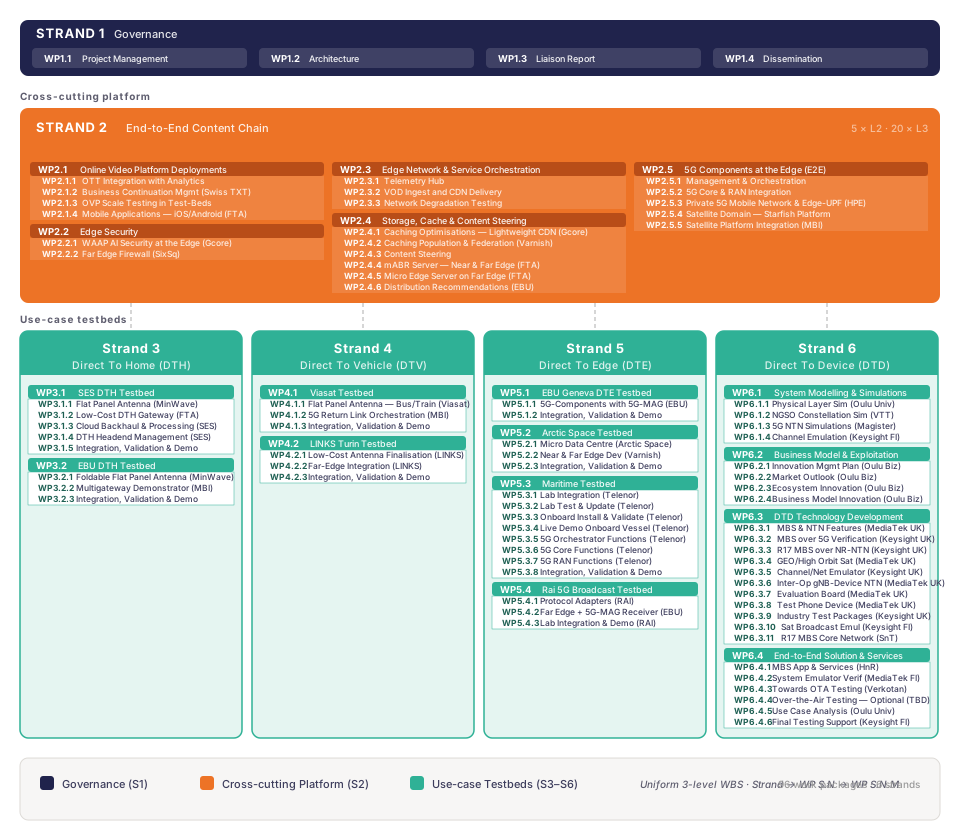 Programme structure showing governance (Strand 1), the cross-cutting platform (Strand 2), and the four use-case testbed strands (S3–S6). 37 work packages across 5 active strands.
The programme is arranged in three strand tiers:
Strand 1 — Governance. Research coordination, architecture definition (the Architectural Blueprint), and dissemination. Strand 1 defines the system design and the testing framework that all other strands work to.
Strand 2 — Cross-cutting platform. The end-to-end content chain: shared components for content provisioning, edge computing, security, telemetry, orchestration, and 5G integration that every testbed builds upon.
Strands 3–6 — Use-case testbeds. Each strand validates the system in a different deployment context, mapped to one of the four use case categories defined in the SAI.
Work Package Register
S1 — Governance
| Work Package | Title |
|---|---|
| WP1.1 | Project Management |
| WP1.2 | Architecture |
| WP1.3 | Liaison Report |
| WP1.4 | Dissemination |
S2 — End-to-End Content Chain
| Work Package | Title |
|---|---|
| WP2.1 | Online Video Platform Deployments and Scenarios |
| WP2.1.1 | Integration of 5G-EMERGE Solution with Existing OTT Application incl. Analytics |
| WP2.1.2 | Business Continuation Management Application (Swiss TXT) |
| WP2.1.3 | Scale Testing of OVP Solution in Test-Beds |
| WP2.1.4 | Mobile Applications — iOS + Android for Far Edge Gateway and Micro-Edge Server (FTA) |
| WP2.2 | Edge Security |
| WP2.2.1 | WAAP AI Security at the Edge (Gcore) |
| WP2.2.2 | Far Edge Firewall (SixSq) |
| WP2.3 | Edge Network and Service Orchestration |
| WP2.3.1 | Telemetry Hub |
| WP2.3.2 | VOD Ingest and CDN Delivery |
| WP2.3.3 | Network Degradation Testing |
| WP2.4 | Optimising Storage, Cache Efficiency and Content Steering at the Edge |
| WP2.4.1 | Caching Optimisations at Edge for Lightweight CDN (Gcore) |
| WP2.4.2 | Caching Population and Federation Component (Varnish) |
| WP2.4.3 | Content Steering |
| WP2.4.4 | mABR Server Developments on Near and Far Edge (FTA) |
| WP2.4.5 | Micro Edge Server on Far Edge (FTA) |
| WP2.4.6 | Distribution Recommendations and End User Profile Setting (EBU) |
| WP2.5 | 5G Components at the Edge (End-to-End) |
| WP2.5.1 | Management & Orchestration (5G Components at the Edge) |
| WP2.5.2 | 5G Core & RAN Integration (5G Components at the Edge) |
| WP2.5.3 | Private 5G Mobile Network and Edge-UPF (HPE) |
| WP2.5.4 | Satellite Domain — Starfish Platform (5G Components at the Edge) |
| WP2.5.5 | Integration of Satellite Platform with Satellite Terminal (MBI) |
S3 — Direct to Home (DTH)
| Work Package | Title |
|---|---|
| WP3.1 | SES DTH Testbed (Antenna, Streaming, Contribution & Telemetry) |
| WP3.1.1 | Prototype Small and Light Flat Panel Antenna for DTH Applications — No Reflector (MinWave) |
| WP3.1.2 | Industrialisation of a Commercially Deployable Low-Cost DTH Gateway (FTA) |
| WP3.1.3 | Cloud Backhauling and Cloud Processing of Live Video Services (SES) |
| WP3.1.4 | Management of the DTH Headend Platform (SES) |
| WP3.1.5 | Integration, Validation and Demonstration — SES DTH (incl. Strand 2 Scalability Tests) |
| WP3.2 | EBU DTH Testbed (Nomadic Antenna, Satellite Gateway-Switch, Playout & Analytics) |
| WP3.2.1 | Optimisation and Validation of Foldable Flat Panel Reflector Antenna for Nomadic Use Case (MinWave) |
| WP3.2.2 | MBI 5G-Orchestrated Multigateway Demonstrator — Fixed and Nomadic (MBI) |
| WP3.2.3 | Integration, Validation and Demonstration — EBU DTH (incl. Strand 2 Scalability Tests) |
S4 — Direct to Vehicle (DTV)
| Work Package | Title |
|---|---|
| WP4.1 | Viasat Testbed (Vehicle Antenna, Link Validation, Strand 2 Integration) |
| WP4.1.1 | Low-Cost Flat Panel Antenna Development for Bus/Train Deployments (Viasat) |
| WP4.1.2 | 5G Return Link Capacity Orchestration (MBI) |
| WP4.1.3 | Integration, Validation and Demonstration — Viasat DTV (incl. Strand 2 Scalability Tests) |
| WP4.2 | LINKS Turin Testbed (2D Phased Array Antenna, Integration, E2E Reception) |
| WP4.2.1 | Low-Cost Antenna Finalisation for Testing in the DTV Scenario (LINKS) |
| WP4.2.2 | Far-Edge Integration for Car DTV Testbed (LINKS) |
| WP4.2.3 | Integration, Validation and Demonstration — LINKS Turin DTV (incl. Strand 2 Scalability Tests) |
S5 — Direct to Edge (DTE)
| Work Package | Title |
|---|---|
| WP5.1 | EBU Geneva DTE Testbed (5G NR UE, Far Edge Streaming, MBS Component Tests) |
| WP5.1.1 | 5G-Components in DTE with 5G-MAG Tools (EBU) |
| WP5.1.2 | Integration, Validation and Demonstration — EBU Geneva DTE (incl. Strand 2 Scalability Tests) |
| WP5.2 | Arctic Space Testbed — Direct to Basestation (GEO/LEO Satellite, Far Edge Cache, 5G Campus Network) |
| WP5.2.1 | End-to-End Testbed for DTE Micro Data Centre Use Case (Arctic Space) |
| WP5.2.2 | Near Edge and Far Edge Development (Varnish) |
| WP5.2.3 | Integration, Validation and Demonstration — Arctic Space DTE (incl. Strand 2 Scalability Tests) |
| WP5.3 | Maritime Testbed (Vessel-based Private 5G, VSAT, Content Delivery) |
| WP5.3.1 | Integrate and Validate in Controlled Lab Environment (Telenor Research) |
| WP5.3.2 | Test and Update Testbed in Controlled Lab Environment (Telenor Research) |
| WP5.3.3 | Install, Integrate and Validate Onboard a Selected Vessel (Telenor Research) |
| WP5.3.4 | Live Demonstration and Test Onboard Vessel (Telenor Research) |
| WP5.3.5 | Development and Testing of 5G Orchestrator Functions (Telenor Research) |
| WP5.3.6 | Development and Testing of 5G Core Functions (Telenor Research) |
| WP5.3.7 | Development and Testing of 5G RAN Functions (Telenor Research) |
| WP5.3.8 | Integration, Validation and Demonstration — Maritime DTE (incl. Strand 2 Scalability Tests) |
| WP5.4 | RAI 5G Broadcast Integration Testbed (LTE-based 5G Terrestrial Broadcast) |
| WP5.4.1 | Prototyping of Protocol Adapters Towards 3GPP Interfaces to 5G Broadcast Transmitter (RAI) |
| WP5.4.2 | Integration of Far Edge with 5G-MAG 5G Broadcast Receiver (EBU) |
| WP5.4.3 | Laboratory Integration, Validation and Demonstration of 5G Broadcast Network with 5G-EMERGE (RAI) |
S6 — Direct to Device (DTD)
| Work Package | Title |
|---|---|
| WP6.1 | System Modelling and Simulations |
| WP6.1.1 | Physical Layer Simulation — Radio Channel and Communication Link Modelling (Oulu University) |
| WP6.1.2 | NGSO Constellation Simulation — Large-Scale System Modelling (VTT) |
| WP6.1.3 | 5G NTN Technology Simulations — Smaller Scale System Modelling (Magister Solutions) |
| WP6.1.4 | Channel Emulation Implementation Based on Simulation Results (Keysight Finland) |
| WP6.2 | Business Model and Service Exploitation Plan |
| WP6.2.1 | Innovation Management Plan (Oulu University Business School) |
| WP6.2.2 | Market Outlook (Oulu University Business School) |
| WP6.2.3 | Ecosystem Innovation (Oulu University Business School) |
| WP6.2.4 | Business Model Innovation (Oulu University Business School) |
| WP6.3 | DTD Technology Development (MediaTek UK / Keysight UK) |
| WP6.3.1 | Integration of the MBS and NTN Features (MediaTek UK) |
| WP6.3.2 | Independent MBS Broadcast over 5G Verification (Keysight UK) |
| WP6.3.3 | Support R17 MBS Broadcast Delivery over NR NTN (Keysight UK) |
| WP6.3.4 | Support of GEO and Other High Orbit Satellites for Device (MediaTek UK) |
| WP6.3.5 | Support Channel and Network Emulator Test Environment (Keysight UK) |
| WP6.3.6 | Inter-Operability Testing gNB-Device NTN (MediaTek UK) |
| WP6.3.7 | Development of an Evaluation Board (MediaTek UK) |
| WP6.3.8 | Development of a Test Phone Device (MediaTek UK) |
| WP6.3.9 | Verify Using Industry Standard Test Packages for NR-NTN (Keysight UK) |
| WP6.3.10 | Channel Emulation Test Environment Development for Satellite Broadcasting (Keysight Finland) |
| WP6.3.11 | Support of Mandatory R-17 Feature for MBS within the Core Network (SnT) |
| WP6.4 | End-to-End Solution and Services |
| WP6.4.1 | MBS Application and Services (HumansnotRobots) |
| WP6.4.2 | Verification in System Emulator (MediaTek Finland) |
| WP6.4.3 | Towards Over-the-Air Testing (Verkotan) |
| WP6.4.4 | Over-the-Air Testing — Partly Optional (TBD) |
| WP6.4.5 | Use Case Analysis (Oulu University) |
| WP6.4.6 | Support for the Final Testing of the Solution (Keysight Finland) |
Further Reading
- Architectural Blueprint — system architecture, functional design, and technology standards
- Test Framework — Phase 2 testing scope and KPI catalogue
- Testbeds — how each testbed realises the logical architecture